Why I Give Every Tool Supplier a $200 Test Order
I judge every tool supplier by how they handle our smallest order. Not the annual contract. Not the impressive quote. The tiny order they think no one is watching.
Here's how it works. And why it's never failed me.
From a $190 Test Order to a Full Vendor Relationship
When I took over tool purchasing in 2020, I inherited the usual mess—legacy vendors, outdated pricing, and a culture of "don't rock the boat." Our maintenance team kept losing specialty tools. Specifically ratchet cable knives—the manual kind for stripping heavy cable in tight spaces. Everyone grabbed one, then it vanished. So I tried to order a dozen from our regular supplier.
Their quote: $280, plus a $75 handling fee because the order fell under their $500 minimum.
Seventy-five dollars. To process a $280 order.
I hesitated. A colleague whose wife is an electrician suggested I look at Metabo HPT. He'd been reading Metabo HPT air compressor reviews while researching shop equipment and kept coming across their name. He said, "They make everything—even a 20 volt chainsaw. And they actually ship fast."
I hadn't seriously considered them. I associated the brand with DIY-grade stuff. But I figured it was worth a shot. I placed a small order: a Metabo HPT circular saw, a box of accessories, and a few other items our warehouses needed. Total: $190.
They nailed it. No minimum. No surcharge. No "can you add $300 more to hit our threshold" email. The order arrived in three days, packed properly, with a clean invoice.
I didn't think much of it at the time. Just another smooth transaction.
The Pattern Nobody Talks About
Later, I started applying the same test to other suppliers. Whenever I needed something new, I'd start small. $200 here, $150 there. Nothing dramatic. Just enough to see how their system actually works.
Over six years—and I'd have to check the exact count, but somewhere around 18 vendors—I noticed a pattern:
- 11 suppliers either charged small-order fees or imposed minimums
- 4 never followed up after the first request
- Only 3 processed small orders without making it feel like a favor
Guess which three I still work with today? All of them.
And the minimum-order crowd? Two got acquired. One raised contract pricing. One lost our business in 2023 after a warehouse mix-up cost us $4,000 in expedited replacements.
"You don't know a supplier until you see them handle a problem they didn't cause." — my old boss, who was right more often than I gave him credit for
What I learned: A company that can't handle a $200 order won't magically improve at $20,000. It's not a scale problem. It's a priority problem.
The "Small Customer" Myth
I want to address a common pushback I hear: Small orders are a waste of time.
No, they're not.
A few years back, I was researching how to work hydraulic jack equipment for our maintenance team—they were troubleshooting a press issue and needed guidance on safe operation. I almost bought from an industrial supplier with a steep minimum order.
But then another company—one I'd tested with a small order months earlier—offered to send two loaner units before we committed. They even let us borrow the tool for a week while we figured out how to work hydraulic jack maintenance right.
That sounds like a hassle, right?
That "small" order turned into a multi-year relationship worth roughly $18,000 annually. We didn't go with the lowest quote. We went with the supplier who treated us like a real customer—not a rounding error.
Here's what people miss:
- Trial orders are how you test packaging, delivery accuracy, and invoice reliability
- Today's small customer might become tomorrow's large account—but good suppliers don't gamble on that; they serve well now
- Budget-constrained teams need flexibility, not rigid minimums
- Standardized tools—like the 20V chainsaw we bought for our outdoor crew, or the circular saw we keep on hand—work better when you can reorder quickly from the same source
I'm not saying suppliers should offer discounts on small orders. I'm saying the "nuisance fee" they charge on small orders costs them long-term relationships.
The Counterarguments (And Why I Disagree)
"Minimums exist for a reason—small orders aren't profitable."
For some products, I accept that. Custom manufacturing? Makes sense. But standard tools and accessories? That's usually a process problem, not a scale problem. A supplier that can't process a $280 order efficiently has a workflow issue, not a margin issue.
"You're just looking for the cheapest option."
No, I'm not. I once paid 15% more on a $190 order to test a supplier who'd handled a small project for us before. I paid more because their invoicing, tracking, and follow-through were reliable. Price is the floor. Reliability is the whole house.
"One small order doesn't tell you everything."
No, but it's a filter. And it filters out a surprising amount of noise. If a supplier fails the small test, I don't proceed.
Bottom Line: What I Actually Want
I'm not saying every small customer becomes a major account. I'm saying good suppliers don't gamble on that possibility. They just do the work.
I don't expect every vendor to accept a $50 order. I don't expect small quantities to get bulk pricing. What I expect is this: Don't make a small order harder than it needs to be.
So, next time you're sourcing tools—start small. Place a test order. See how they handle it.
That small order will tell you everything you need to know.
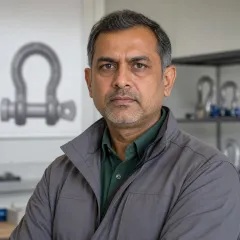
Rajiv Menon
Rajiv Menon is an independent rigging and lifting hardware analyst covering shackles, chain hoists, hooks, turnbuckles, wire-rope clips, and lifting attachments. He applies ISO 2415:2022 shackle requirements while evaluating working load limit, grade, proof load, design factor, pin fit, sling angle, reeving, brake behavior, identification, inspection, and temperature range. His safety-led guides help lifting teams and purchasers select compatible hardware, interpret markings, establish inspection criteria, and avoid side loading or undocumented substitutions.