Why I Stopped Buying Cheap Tools for Small Jobs (And the $2,100 Lesson That Forced the Change)
Small Jobs Don't Deserve Cheap Tools
I'll say the thing that gets me side-eyed at contractor meetups: if you're buying bargain-bin tools for your small jobs, you're not saving money. You're borrowing trouble at a terrible interest rate.
I know because I did it for years. I ran a two-man operation doing punch-list work, small remodels, and the kind of jobs that big outfits won't touch because the margin is too thin. And for the first three or four years, I bought the cheapest circular saw, the cheapest nail gun, the cheapest angle grinder I could find. My logic was simple: small job, small budget, small tool investment. That logic cost me roughly $2,100 in wasted time, rework, and one very uncomfortable conversation with a client.
I don't have hard data on how many small contractors make this same mistake, but based on the guys I've trained and the forums I lurk on, my sense is it's most of us at some point. So let me walk through why this thinking is backwards, and what actually changed my mind.
The Real Cost of a Cheap Tool Isn't the Price Tag
Argument 1: Downtime Doesn't Care About Your Job Size
In March 2019, I was doing a small exterior trim job—maybe $800 total, two days of work. I was using a budget circular saw I'd picked up for $59. Halfway through the second day, the blade guard seized up mid-cut. Not a huge deal, right? Except the blade was buried in a piece of fascia board, and when the guard jammed, the saw kicked back and gouged a 14-inch scar across a piece of pre-finished trim I'd already installed. Then the motor started smoking.
I had to: buy a replacement saw that afternoon (the nearest big-box store had one option in stock—a $130 mid-tier model), re-order the trim ($85 with shipping), and eat a half-day of labor. Total damage: roughly $310 on an $800 job. That's a 38% hit to my margin because I saved $40 on a saw.
Here's what I should have understood: a circular saw is not a job-specific tool. It's a general-purpose tool that you'll use on every job, big or small. The rear handle circular saw I eventually switched to—a Metabo HPT model a buddy let me borrow—cost more upfront, but it's been cutting straight and true for five years now. That's the thing about pro-grade tools: they're not more expensive. They're just paid for over a longer period.
Argument 2: Troubleshooting Is Easier When You Know the Tool Is Good
Nothing wastes time like trying to figure out why a nail gun is misfiring when you don't trust the tool to begin with. I spent an entire Saturday in 2021 trying to troubleshoot a brad nailer that kept jamming. I cleaned it, oiled it, swapped nails three times. Turned out the driver blade was slightly bent—a manufacturing defect, not user error. But I couldn't know that because I'd bought a no-name brand with zero documentation and no parts availability.
When I finally switched to a Metabo HPT nail gun, the troubleshooting process was completely different. There was a manual. There were forums with people who actually used the tool. And when something went wrong—which was rare—I could diagnose it in 10 minutes instead of wasting half a day. If you've ever done nail gun troubleshooting on a cheap unit, you know exactly what I mean. You're just guessing. And guessing is expensive.
Argument 3: The Small Jobs Add Up—and So Does the Tool Wear
Here's the part I didn't understand for years: small jobs aren't a one-time thing. They're a volume business. If you do 30 small jobs a year, your tools are getting used 30 times more than a homeowner's tools. But cheap tools are designed for homeowners. They're built for maybe 50 hours of total use. Pro-grade tools are built for 500 or 1,000 hours.
This extends to every part of your kit. I've replaced more lawn mower parts on cheap mowers than I care to count—belts, blades, spindle assemblies—because the whole machine was built to a price point. Same with plumbing tools. I once had a ball valve replacement handle snap off in my hand because the metal was pot metal, not brass. That was a $12 part that turned into a $400 emergency repair because the valve was stuck open and I couldn't shut off the water main in a client's basement.
When I look at my Metabo HPT tools—the saw, the nailers, the grinder—I don't see a premium price. I see fewer replacements, fewer repairs, fewer apologies to clients.
But Wait—Isn't This Just Brand Loyalty Talking?
I know what some of you are thinking: "Sure, this guy drank the Metabo HPT Kool-Aid. Of course he's going to say buy the expensive stuff."
Fair. So let me clarify my position: I'm not saying you need to buy the most expensive tool on the shelf. I'm saying you need to buy the right tool for the workload. For a homeowner doing one deck project, a $79 circular saw is perfectly fine. But if you're a contractor—even a small one—your tools are your production equipment. They're not a cost center. They're the thing that lets you earn money.
And honestly, I've used DeWalt, Makita, and Milwaukee tools too. They're all good. I'm not saying Metabo HPT is the only option. I'm saying that moving up from the budget tier to the pro tier matters more than which pro brand you pick. The difference between a $59 saw and a $179 saw is enormous. The difference between a $179 saw and a $229 saw is mostly preference.
I also want to be clear about context: I work in the U.S., mostly on residential jobs. If you're doing heavy industrial work or working in extreme conditions, your calculus might be different. And if you're just starting out and truly can't afford pro-grade tools yet, buy the best you can afford and upgrade as you go. But don't pretend the cheap tool is just as good. It's not. It's just cheaper upfront.
The Lesson That Stuck
In 2018, I made the classic newbie mistake of buying a tool because it was on sale, not because it was right for the job. It was an angle grinder—$39, no-name brand. I needed to take a disc off an angle grinder for the first time, and the spindle lock was so poorly machined that it stripped the first time I used it. I ended up having to cut the disc off with a Dremel. That's a 45-minute detour on a 10-minute task.
I still have that grinder somewhere. I keep it as a reminder. Every time I think about saving $50 on a tool that I'll use 200 times a year, I look at it and remember: the cheap tool isn't cheap. It's just a different payment plan—one with worse terms.
So here's my challenge to you: next time you're pricing out a tool for a small job, add up the real cost. The tool, the downtime if it fails, the rework if it's inaccurate, the replacement when it dies. Then compare that to the pro-grade version. I think you'll find the math isn't even close.
Small jobs deserve good tools. Small clients deserve good work. And you deserve to stop wasting your weekends troubleshooting equipment that was never built to last.
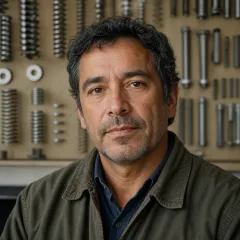
Victor Salcedo
Victor Salcedo is an independent fastener, anchor, and spring analyst covering screws, bolts, nuts, washers, rivets, anchors, compression springs, extension springs, and torsion springs. He uses ISO 898-1 property classes alongside clamp-load, thread engagement, proof load, corrosion exposure, anchor substrate, spring rate, travel, and fatigue-cycle checks. His engineering explainers help designers and buyers specify reliable joints or elastic elements, compare materials and finishes, and avoid mismatched strength assumptions.